Premonition CRM Magnetics CRM Magnetics
AI Search Visibility Audit

An audit of
premonition.ai's
AI search visibility.

We ran 16 litigation-analytics category queries across ChatGPT, Perplexity, and Google AI Overviews - 48 total answers - and mapped which platforms AI hands the recommendation to when insurance carriers, corporate legal teams, and litigation funders ask for counsel-selection, judge analytics, and outcome-prediction tools.

Prompts tested
16
Engines
3
Prepared
May 12, 2026
premonition.ai
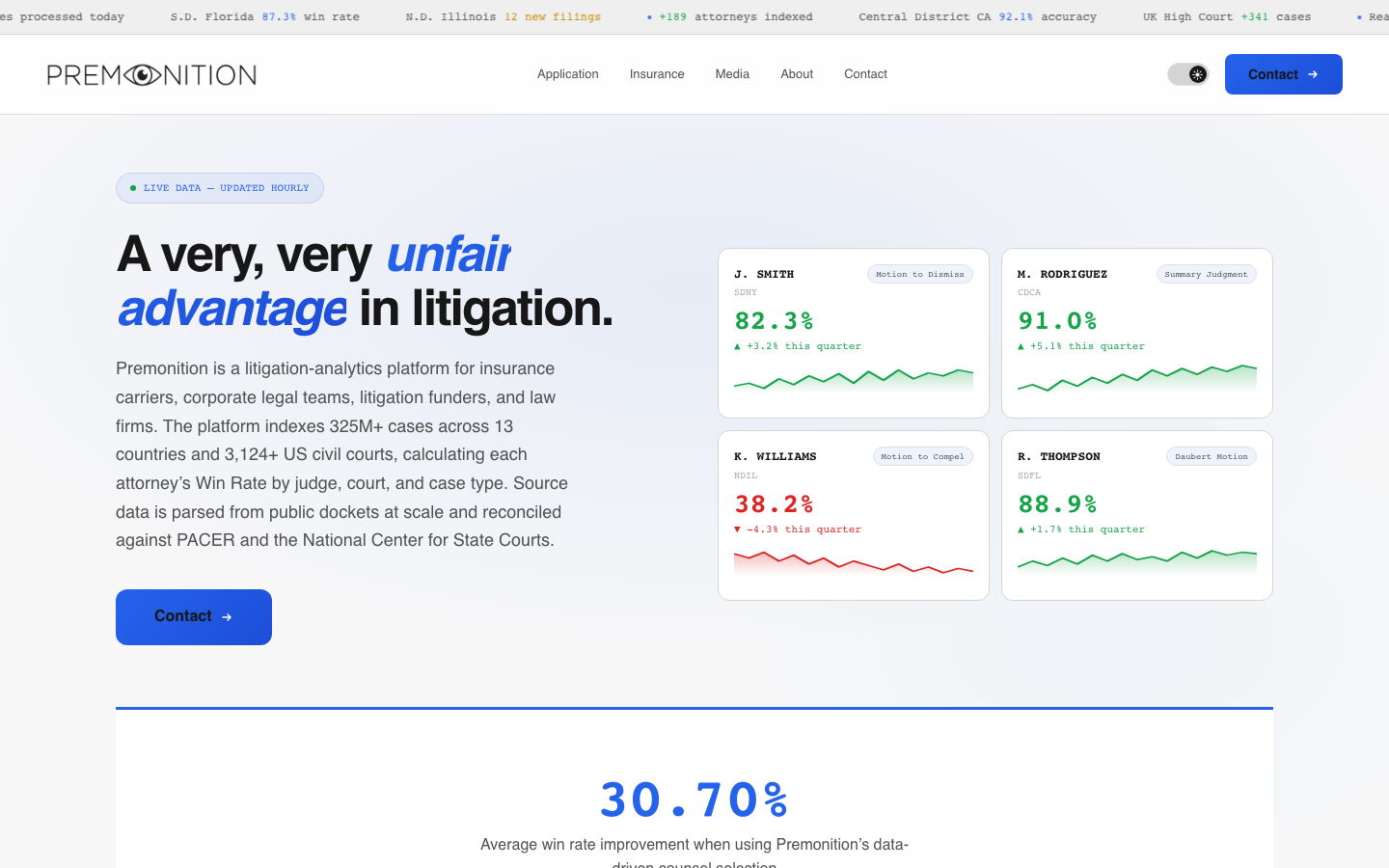
premonition.ai homepage
The One Thing 01
2/48
AI answers that named Premonition across 16 litigation-analytics queries.
Across 48 AI answers to litigation-analytics category queries, Premonition was named 2 times. Thomson Reuters was named 6 times, CLARA Analytics 4.

None of this shows up in Search Console or GA4. AI engines fetch and read premonition.ai constantly to answer questions like these, but rarely send a click through - so a dashboard built to count clicks has nothing to show for a fetch that already happened. That's a gap in what click-based analytics can measure, not how Premonition tracks its site. The homepage scores 3.0 / 10 on passage citability and ships zero JSON-LD schema, so even the fetches that do happen have little to cite.

The Competitive Picture 02

Who AI hands the answer to.

The brands appearing most often when a buyer asks AI a question Premonition could plausibly own. Pulled live from ChatGPT (GPT-4o web search), Perplexity (Sonar), and Google AI Overviews on May 12, 2026. Reference / academic sources (Villanova, Harvard, SSRN) noted but not weighted as competitors.

1
Thomson Reuters
Category giant · Westlaw Litigation Analytics, Practical Law
2
CLARA Analytics
Direct peer · AI claims optimization for insurers
3
Trellis.law
Direct peer · state court analytics, judge insights
4
Milliman
Adjacent peer · insurance actuarial / claims consulting
5
Gen Re
Adjacent peer · reinsurance + claims analytics
6
Premonition
You · one ChatGPT cite, one Perplexity cite, zero AIO
7
ClaimDeck
Direct peer · litigation management for carriers
8
Pre/Dicta
Direct peer · litigation outcome prediction
9
Nexlaw.ai
Direct peer · AI legal-analytics startup
10
Riskonnect
Adjacent peer · integrated risk management

What the engines actually said.

Three answers, verbatim. The competitors named in bold are the ones being recommended when insurance and corporate-legal buyers ask AI for counsel-selection and outcome-prediction tools.

Not our summary - the engines' actual words, verbatim, unedited.

ChatGPT
GPT-4o · web search
"best litigation analytics platform for insurance carriers"

For insurance carriers seeking effective litigation analytics platforms, several solutions offer advanced tools... CLARA Analytics, a leader in AI-driven commercial insurance claims optimization, partnered with ClaimDeck, a SaaS-based litigation management platform. This collaboration aims to help carriers manage litigation rates and improve legal outcomes. Premonition.ai provides a comprehensive litigation intelligence application covering over 325M+ cases...

Cited: claraanalytics.com · milliman.com · premonition.ai · prnewswire.com
Perplexity
Sonar
"best alternative to Lex Machina for legal analytics"

Lex Machina (now part of LexisNexis) excels in predictive litigation analytics... Based on recent comparisons from G2, CB Insights, legal blogs, and vendor analyses (as of 2026), here are the top alternatives... Westlaw Litigation Analytics (Top Overall Pick): Comprehensive judge analytics, motion success rates, docket patterns, and venue comparisons. Trellis.law: state court analytics with strong judge insights. Pre/Dicta: predictive litigation outcomes.

Cited: cbinsights.com · g2.com · nexlaw.ai · trellis.law · villanova.edu
Google AI Overviews
SERP feature
"16 litigation-analytics queries tested"

No AI Overview generated for any of the 16 queries we ran. Google declined to summarize legal-analytics queries, defaulting to standard organic SERPs. Per Ahrefs (late 2025), AIO trigger rates have dropped in YMYL / high-stakes professional categories - and when AIO does trigger, 38% of citations come from the organic top 10. Premonition doesn't rank in the top 10 organically for these queries either.

The Teardown 03

Your opener vs. what they cite.

AI engines don't cite pages - they cite passages, the first 60 words especially. 44% of all LLM citations come from the opening of a page (Averi.ai 2025). Here is the homepage opener and what it would need to be.

Current - premonition.ai homepage · 3.0 / 10

Slogan-first opener, no category definition, no outbound citation.

"A very, very unfair advantage in litigation. Because losing is expensive. Premonition analyzes 325M+ cases across 13 countries to calculate every lawyer's Win Rate by judge, court, and case type."
Direct Answer (BLUF)
0 / 1
First sentence is a tagline ("very, very unfair advantage"), not a definition. The third sentence finally answers what Premonition is.
Definitional Opener
0 / 1
No '[Brand] is a [category] for [audience]' sentence. The buyer category (insurance carriers, corporate legal, litigation funders) is named on /insurance and /application, never above the fold on the homepage.
Outbound Citation
0 / 1
Zero outbound links to PACER, the Federal Judicial Center, NCSC court data, or any authoritative source - despite Premonition's entire value proposition resting on court-record provenance.

Why it fails. Slogan-first opening - a softer form of the marketing-voice anti-pattern. Unlike most sites we audit, Premonition's first paragraph does contain real statistics (325M+ cases, 13 countries) - the strongest single Princeton GEO lever. But a retriever extracting the first 60 words gets very, very unfair advantage, losing is expensive ahead of the substance. Stripping the tagline and leading with the definition would lift this score without changing any of the firm's positioning - the slogan still lives above the fold visually, just not at the top of the extractable chunk.

What the same opening should be.

The same opening real estate, rewritten using Pattern 1 - definitional lead with stat anchor. Brand voice survives below the fold; the extractable text block now answers the category query in the first 60 words.

Target - Pattern 1: Definitional Lead with Stat Anchor

What the same opening should be.

"Premonition is a litigation-analytics platform for insurance carriers, corporate legal teams, litigation funders, and law firms. The platform indexes 325M+ cases across 13 countries and 3,124+ US civil courts, calculating each attorney's Win Rate by judge, court, and case type. Insurance carriers using Premonition have reported 8-12% annual litigation-spend savings and 15-20% reductions in case duration. Source data is parsed from public dockets at scale and reconciled against PACER and the National Center for State Courts."

What changed. The "very, very unfair advantage" tagline moves below the fold (it stays as the visual hero - this rewrite only swaps the extractable text block). First 90 words now answer what is Premonition with a category (litigation-analytics platform), a four-segment audience (carriers, in-house, funders, law firms), the scale anchors that were already there (325M+ / 13 / 3,124+), the outcome metrics from the /insurance page (8-12% / 15-20%), and two outbound citations to source-of-truth authorities. Princeton GEO measured +41% on Quotation, +31% on Statistics, +28% on Cite Sources - the rewrite stacks all three.

What the Data Says 04

Findings, in order of impact.

Every finding traces to a specific data point and a named failure mode. We share the raw audit files with any prospect that moves to a call.

Critical

Slogan-first opener on the homepage - 325M+ stat is present, but the third sentence, not the first.

Premonition is the rare audit where the data is on the page - 325M+ cases, 13 countries, 3,124+ courts, 30.7% average win-rate improvement, 8-12% litigation-spend savings on /insurance. But the homepage leads with "A very, very unfair advantage" and "Because losing is expensive" before getting to the definition. A retriever extracting the first chunk indexes the slogan, not the proof. Princeton GEO (KDD 2024) measured +41% on Quotation and +31% on Statistics; Premonition has the statistics, they just aren't first.

Critical

Zero JSON-LD schema across 40 pages. No Organization, no sameAs hub.

premonition.ai ships no structured data. No Organization with the awards (National Law Journal AI Leader 2018, Top 100 Most Disruptive Legal Companies 2017) marked up as award. No SoftwareApplication on /application. No Article on the 14 /media/ posts. Zero sameAs links to CNBC / Bloomberg / Forbes coverage, Crunchbase, LinkedIn, or any of the trade publications the /about page lists. Vendor research suggests schema lifts citation 2.5-3.2× (Frase, Schema App); Search/Atlas (n=3) found no correlation. Treat schema as the entity baseline AI engines need to disambiguate "Premonition" from the unrelated companies sharing the name, not a guaranteed lever.

High Impact

13+ /blog/* URLs return 404 - the /media/ archive moved but the old paths weren't redirected.

Every legacy /blog/2018-*, /blog/2019-*, and /blog/2021-* URL we crawled returns the site's 404 template, while the same content lives - and resolves - at /media/.... National Law Journal, Insurance Research Letter, and Robin Hanson podcast pages are all affected. Every external backlink to the old paths is wasted; every cached AI-engine reference to the old URLs lands on 404. Easy fix: 301-redirect each /blog/<slug> to /media/<slug>.

High Impact

No off-site footprint AI engines treat as authoritative for legal analytics.

Perplexity's legal-analytics answers cite G2, CB Insights, Villanova, Harvard, SSRN, Thomson Reuters, and category peers (Trellis, Pre/Dicta, Nexlaw). Premonition appears in none of the directories or listicles AI engines actually pull from - no G2 profile for litigation analytics, no Capterra entry, no CB Insights tag, no inclusion in the ACC (Association of Corporate Counsel) tech directory, no recent Lawnext or Above the Law write-up. The awards on /about (National Law Journal, AL 100, Predictive Analytics Today) are real, but the engines don't see them - the pages those awards live on don't link back to premonition.ai. Hallam Agency's analysis suggests unlinked brand mentions correlate with AI visibility roughly 3:1 over backlinks; Premonition has the mentions historically but not the persistent directory anchors.

Moderate

llms.txt is well-built but most-recent media post is from 2021.

The 69 KB llms.txt at /llms.txt is properly formatted and lists every page with descriptions - better than 99% of sites we audit. llms.txt impact is contested in our source brief (Google has stated they don't read it; SE Ranking and others recommend it anyway). Treat the existing file as low-cost optionality. The bigger freshness issue: the newest /media/ post is from July 2021 - five years of silence on a category (legal AI, predictive analytics) that has moved fast. Princeton GEO's freshness signal favors recently-dated content; Premonition's archive reads as a company that stopped publishing in 2021.


Three Moves 05

What we'd do first, if this were ours.

Ranked by leverage-to-effort, not by difficulty. Pick one and start.

1

Lead the homepage with the definition - keep the slogan as the visual hero, swap the extractable text.

Days 1-14·Highest Impact

This is the rewrite shown in §03. "A very, very unfair advantage" stays as the visual headline; the paragraph underneath gets replaced with the definitional opener (category + four-segment audience + 325M+ / 13 / 3,124+ + 8-12% / 15-20% outcome metrics + two outbound citations to PACER and NCSC). Mirror the same structure on /application, /insurance, /lobbying, and /law-enforcement using each page's own stats. Effort: 4-6 content hours. Highest single-leverage change in the audit, and the underlying stats already exist - this is reordering, not invention.

2

Ship Organization, SoftwareApplication, and Article JSON-LD across the site.

Days 1-14·Foundational

Organization schema on the homepage with name, legalName, url, logo, foundingDate, award (the National Law Journal AI Leader / AL 100 / Top 100 Disruptive entries already on /about), and sameAs linking to Crunchbase, LinkedIn, CNBC / Bloomberg / Forbes coverage URLs, and any Wikidata entry (create one if absent). SoftwareApplication schema on /application with applicationCategory, featureList, audience. Article schema on the 14 /media/ posts. Effort: 6-10 dev hours. This is the entity baseline AI engines need to recognize Premonition as a discrete, awarded vendor rather than a generic noun.

3

Get into the 4-5 directories AI engines actually cite for legal analytics - and reanimate publishing.

Days 30-90·Compounds Month-Over-Month

Submit to G2 (Legal Research / Legal Analytics categories), Capterra, CB Insights, the ACC tech directory, and at least one Above the Law / Lawnext round-up. Pitch one guest piece a month to Lawnext, Legal Tech Hub, Artificial Lawyer, and the ABA Journal - each piece dated 2026, with an author byline + Person schema. Consistent NAP and the same sameAs hub across every profile. Off-site presence compounds: every additional listing and bylined piece increases the probability Premonition surfaces when Perplexity fans out a query and pulls 60+ candidate sources.

Next Step

A 30-minute walk-through of this audit, on us.

We'll verify the data we couldn't fully access (backend Search Console, GA4 organic, branded-search lift, the 404'd /blog/ paths' historical traffic), pressure-test the three moves above against Premonition's actual roadmap, and - if there's fit - sketch what the first 90 days look like.

See the full walkthrough

Or reply to the email this report came with. No deck, no pitch - just the data.

Methodology 06

How this was made.

Every claim in this report is grounded in data captured on May 12, 2026. Anywhere we couldn't verify, we said so.

What we pulled

Site crawl40 pages of premonition.ai - full HTML and markdown, robots.txt, llms.txt (69 KB, well-formed), JSON-LD blocks (none found), all five primary product / vertical pages, 14 /media/ posts, 13 /blog/* 404s.
AI engine answers16 litigation-analytics category queries × 3 engines (ChatGPT GPT-4o web search, Perplexity Sonar, Google AI Overviews) = 48 answers. Cited domains parsed from each. 32 of 48 returned content; AIO declined to summarize all 16 legal queries.
Passage citabilityEvery page scored against a 10-dimension rubric: BLUF, statistics density, definitional opener, outbound citations, chunk size, self-contained chunks, schema-anchoring, entity-explicit, question-mirror, TL;DR.
Schema auditJSON-LD type counts, sameAs link inventory, Organization / SoftwareApplication / Article / Person / FAQ presence.
Competitive setDomains cited 2× or more across the 48 answers, ranked by mention count and tagged by profile (direct peer, adjacent peer, category giant, directory, reference / academic).

What we couldn't verify

Backend Search Console performance, GA4 organic traffic, branded-search lift, conversion attribution from /insurance vs /application, historical traffic to the 13 broken /blog/* URLs, Win-Rate-API customer mentions on Reddit / r/LawFirm / r/Insurance. These need owner access we don't assume on a cold audit - we cover them in the walk-through.

What's not in this free version

Per-prompt confidence scoring, sentiment of cited mentions, hallucination flags, monitoring panel (weekly re-run to track lift over 90 days), brand-mention extraction across Reddit / Lawnext / Above the Law / Artificial Lawyer / ABA podcasts.

CRM Magnetics · May 12, 2026 · premonition.ai